The biggest challenges in engineering don’t fit neatly into one bucket — they need solutions that pull from multiple fields. A new engineering major at Brandeis builds from that premise.
(photo by Dan Holmes)
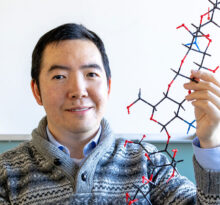
Ben Rogers
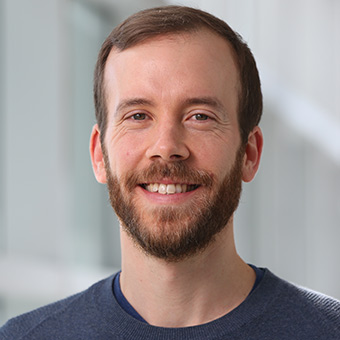
Ben Rogers isn’t a physicist, at least not by training — both of his degrees are in chemical engineering. Yet his office sits inside Brandeis University’s physics department, a few doors down from colleagues studying black holes, subatomic particles, and the weather on distant planets.
His work may seem out of place in this company, but that’s exactly the point. Rogers, who also chairs Brandeis’ new engineering science program, is one of a growing number of faculty at Brandeis whose research doesn’t slot neatly into any one field. Instead, it harnesses expertise and techniques from multiple scientific disciplines and combines them to solve some truly thorny problems — which, he adds, is precisely the mode of thinking that he wants to instill in the first class of engineering majors on campus this fall. Instead of bucketing students into traditional engineering specialties, the program’s aim is to teach them tools and strategies to tackle complex questions across multiple fields.
Building Small
The current challenge Rogers works on is a doozy: figuring out how to build nano-scale machines that assemble entirely on their own, without being guided by a human hand. It’s something nature has been doing for billions of years — it’s how a protective shell forms around a virus, and how the inner workings of a cell emerge from a soup of proteins, nucleic acids, and lipids. The process is far more elegant than anything we humans have developed: At the moment, we still largely assemble our devices (more or less) the way we always have, one weld or rivet or line of code at a time.
But Rogers and a small circle of colleagues at Brandeis think that’s about to change. The next frontier of engineering, they say, will occur at scales thousands of times smaller than the thickness of a human hair. If correctly designed, microscopic machines could eventually assemble themselves from a stew of raw materials, hunt down environmental toxins, deliver drugs straight to a single diseased cell, or complete other tasks no one has yet imagined. It’s a bold vision of the future, but it will only exist if researchers can figure out the basic parameters and techniques needed to construct these tiny devices. There are plenty of hurdles to overcome along the way, Rogers says.
“One of the biggest challenges in the area of self-assembly is developing the principles of engineering at those scales,” he notes. “Let’s say I want to create some complex, three-dimensional structures that can self-assemble — How do I design the building blocks? How many different types of building blocks do I need? What should their shapes be? What should their mutual interactions be?”
Origami on a Microscopic Scale
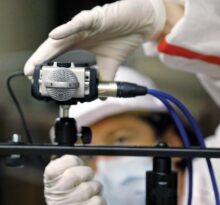
Professor Seth Fraden in his lab at Brandeis. (photo by Dan Holmes)
These sorts of questions, Rogers insists, are essential for any engineering endeavor, whether it’s designing bridges, robots, or tiny molecular machines. Any project has baked-in restrictions, like material properties, cost, or size constraints — so instead of tackling issues specific to one field, like electronics or mechanical design, he and his colleagues want to imbue new engineering students with a generalized problem-solving mindset. His own work illustrates why that’s so important.
In the abstract, assembling something from miniscule building blocks sounds like a simple task. Yet at tiny scales, the orderly world we’re familiar with is turned upside down. To get a sense of how difficult it is to build something in that environment, try a short thought experiment. Picture an automotive factory, where everything is ticking like clockwork: Robots on an assembly line lift individual pieces into place, one after another, in a predetermined order — first the car’s frame, then its doors, windows, and so on. It’s a neat, sequential, top-down process.
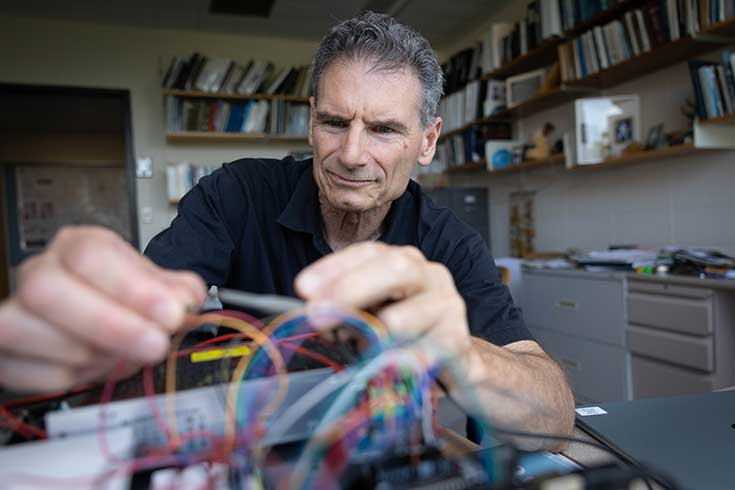
If you shrink the factory down to the nano scale, that careful order will completely vanish, says Seth Fraden, PhD’87 a Professor of Physics who collaborates closely with Rogers and also teaches in the university’s new engineering program.
“It’d be total chaos. Everything would just be floating in space, rocketing around at crazy angles, defying your will to sit still and come together — and things that do come together can fly apart,” he says. Fraden, a physicist by training, has spent the past decade thinking as an engineer: bit by bit, he’s figuring out new ways to work within the chaos.
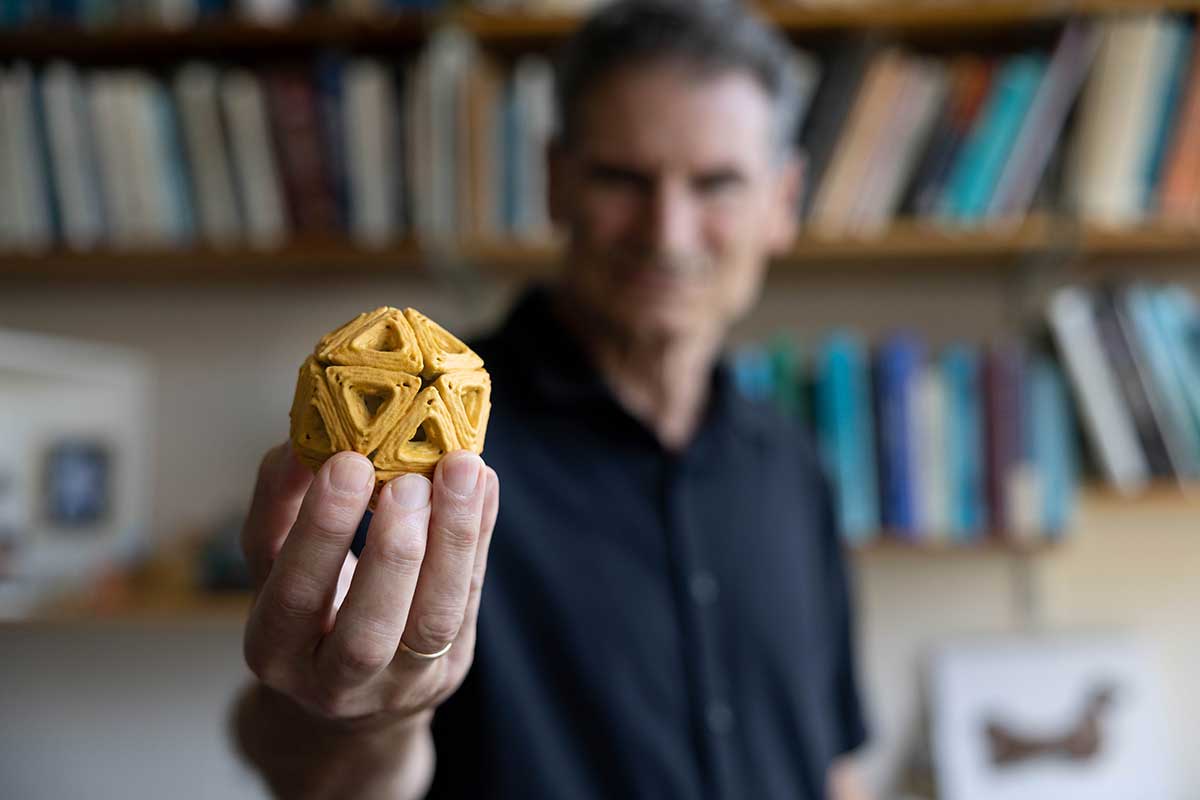
To do this, both Fraden and Rogers use a technique called “DNA origami.” It’s more or less what it sounds like: using a computer and sophisticated lab equipment, the researchers design custom strands of DNA that can fold larger, unstructured DNA molecules into new shapes. These custom strands, called “staples”, snap together disparate regions of the larger DNA molecule, squeezing it into a specific shape like a triangle.
Researchers can then add new bits of programmed DNA to the edges of that triangle, creating points that attract or repel other triangles floating nearby. Like pieces of a child’s Lego set, those component parts then click together in exact ways, creating a tiny 3D structure. Depending on the DNA sequence the individual parts contain, they might come together into a miniscule geodesic dome, a hollow sphere, a long tube, or anything else their designer desires.
Manipulating DNA isn’t the end goal of Fraden and Rogers’ research, though. Both scientists insist that it’s just the beginning. The next big challenge, they say, will be getting those shapes to actually do something.
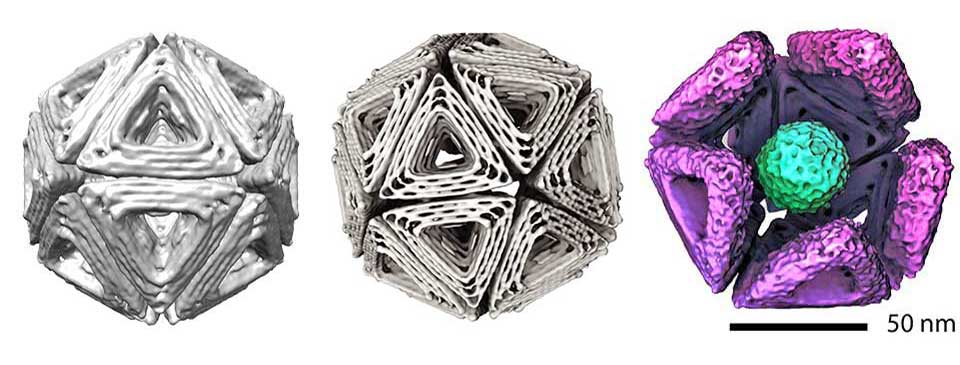
Electron microscope images of tiny structures made with DNA origami techniques.
Fraden’s and Rogers’ labs offer one clear example of where that work might lead: over the past few years, their teams have figured out how to use DNA to build tiny tubular structures that match the shape of viruses like Ebola. DNA is more or less inert chemically, so it can’t interact with the virus on its own — but Fraden and a collaborator, German researcher Hendrik Deitz, were able to place a protein antibody inside the structure, forming a key addition that traps viruses inside the tubule. Once enclosed, the viruses are effectively sequestered until the immune system can destroy them. It’s not theoretical — several companies are already exploring how to bring a version of this technology to the market.
In the meantime, Fraden and Rogers are using their experience folding DNA to hash out the basic rules for building structures at this tiny scale. Eventually, the pair hope those rules could help lead to custom nanomachines made largely of proteins — molecules that could do real chemical work, from attacking tumors to cleaning up toxic waste.
“Whether you’re working with DNA or with proteins, the engineering principles for manufacturing at this scale remain the same,” Fraden says. “DNA origami elucidates the principles; the applications will come from applying these principles to other molecules like proteins.”
The Principle of the Thing
This principle-oriented approach drives the curriculum that Fraden and Rogers have helped develop for Brandeis’ engineering science major, which will make its debut with students this fall. Like their research, the major doesn’t ask students to master one narrow engineering discipline. It asks them to do something closer to what the two scientists do every day: identify the underlying rules of a problem, wherever those rules happen to live, and build something that works based on those rules.
None of this emerged from a single discipline. It came from a physicist willing to train like a bioengineer, and a research culture that never insisted those categories stay separate in the first place.
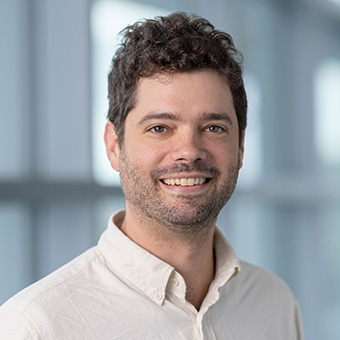
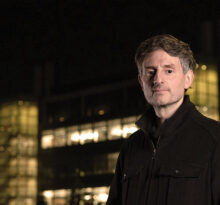
Jonathan Krones
That, more than any single technical result, is what Brandeis is trying to achieve in its new engineering program. “We’re really teaching students to solve problems that are ill-suited for a single discipline,” says Jonathan Krones, Associate Professor of Engineering, who helped design the program’s curriculum. Rather than offering separate tracks in mechanical, electrical, or civil engineering, he adds, the program intentionally teaches a shared foundation — design, instrumentation, modeling, controls — then lets students specialize through electives that mirror research already happening on campus: materials science, environmental engineering, robotics, biomedical engineering.
The intent, Krones says, is to train students for jobs in fields that don’t fully exist yet — students who can move fluidly between a scientist’s questions and an engineer’s answers, doing a kind of translation work that most traditional engineering programs never teach.
“Our goal is to give students the ability to use a broad tool kit of engineering math and science, and an understanding of real-world constraints and needs — legal, practical, ethical, environmental — to be very creative in problem solving,” Krones says. “That’s what makes a Brandeis engineer distinct from any other kind of technical thinker.”